



RAYMOND, WI — The final day of testimony in Jeff Peterson v. Raymond School District focused on former Raymond School Board member Amanda Falaschi.
Her appearance on March 4 ended a seven-day administrative hearing that has examined Peterson’s discrimination, retaliation and Family and Medical Leave Act claims against the district.
Under questioning from Peterson’s attorney, Wes Haslam, Falaschi repeatedly testified that she did not recall key events, documents and communications, including a litigation hold letter and whether she possessed or produced messages related to Peterson.
“I don’t recall,” Falaschi responded multiple times during Haslam’s direct examination as he asked about discovery production, personal account communications and earlier investigative materials.
When Lubinsky began her examination, Falaschi provided more detailed responses about the same events and issues she had struggled to recall under Haslam’s questioning, including her reasons for running for the school board and her concerns about discipline in the district.
“I had kids that were in the school district, and we were experiencing issues with bullying,” Falaschi testified, explaining she believed there was “a lack of discipline within the school.”
Falaschi said those concerns prompted her to seek a meeting with Peterson about the issue.
“I was told he wouldn’t meet with me,” she testified, saying that response contributed to her decision to run for the board.
When Lubinsky began her examination, Falaschi offered detailed testimony about her volunteer history, when she was elected, her later role as board clerk and why she ran for office, describing concerns about bullying and discipline as her motivation.
“I had kids that were in the school district, and we were experiencing issues with bullying,” Falaschi testified, explaining she felt there was “a lack of discipline within the school.” She said she sought a meeting with Peterson and was frustrated when she was told he would not meet with her directly.
Litigation hold letter and investigation records
Haslam questioned Falaschi about an August 21, 2023 litigation hold letter sent to her school board email, asking whether she remembered receiving it.
“No,” Falaschi testified when asked if she recalled receiving the letter, and again testified she did not recall discussing it with anyone.
Haslam also asked about an investigation report authored by attorney Jonathan Sacks, including a highlighted reference stating Falaschi had provided a Facebook direct message to the investigator. Falaschi testified she did not recall the specific message.
“I don’t recall exactly, but it sounds possible,” she said.
When Haslam pressed whether she provided that material in discovery, Falaschi again testified she did not remember.
Campaign support, Moms for Liberty and deposition impeachment
A major portion of Haslam’s questioning centered on Falaschi’s school board campaign and her ties to individuals connected to community activism around Raymond School, including Art Binhack from Convention of States and Joanne Koenecke.
Haslam identified Koenecke during questioning as being affiliated with Moms for Liberty, and Falaschi acknowledged she was aware.
When asked if Moms for Liberty supported her campaign, Falaschi testified, “Not directly.”
Moms for Liberty has chapters in states across the country, including in Racine County, and has been classified as a hate group by the Southern Poverty Law Center because of the group’s anti-LGBTQ+ rhetoric.
Haslam then used Falaschi’s deposition transcript to challenge her memory about whether Koenecke supported her campaign. Falaschi ultimately testified that if she said it in the deposition, then it was accurate.
“I don’t recall, but if I said that in August, then yes,” she said.
Haslam also asked whether Binhack supported her campaign.
“Yes, I believe so,” Falaschi testified.
Text messages contradict parts of Falaschi’s testimony
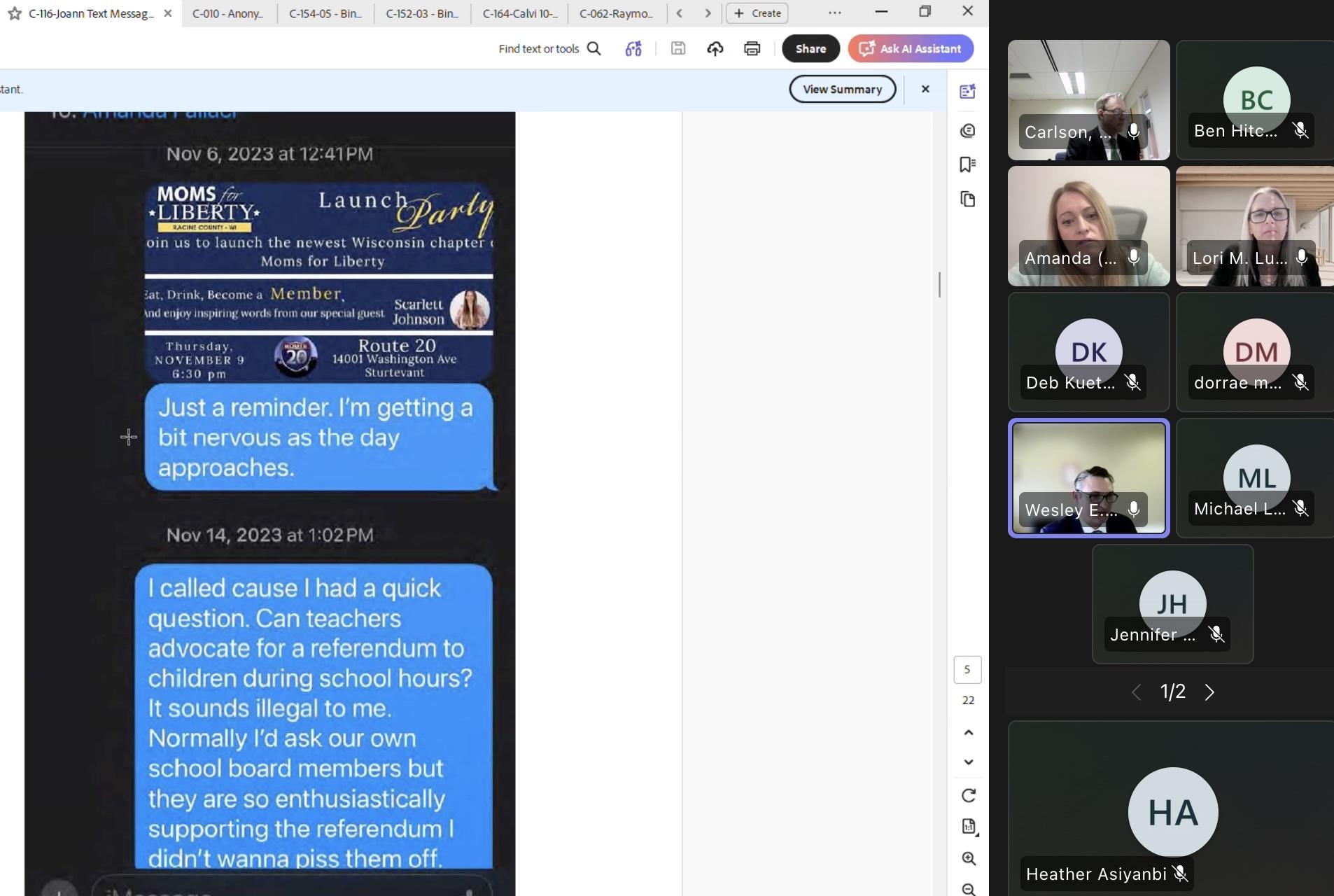
Haslam then introduced a lengthy set of text messages between Falaschi and Binhack and walked her through them page by page, using the exchange to challenge her earlier testimony minimizing campaign coordination.
The messages included discussions about signs, campaign outreach and coordinated voter messaging. In one exchange, Haslam highlighted texts discussing automated messages advocating for both candidates, and another in which Falaschi indicated she was encouraging voters to support Binhack as well.
Haslam also questioned Falaschi about texts that referenced former Raymond Village President Kari Morgan and a local political website dispute over who should be listed as conservative candidates, including a line in which Binhack told Falaschi, “Kerry Morgan sent that to me,” which Falaschi acknowledged.
Haslam further highlighted an exchange in which Binhack wrote that the two candidates had “the majority, three to two,” and referenced electing a board president.
Haslam then asked Falaschi whether the three referenced were herself, Gwen Keller and Audrey Kostuch, to which Falaschi agreed in substance, testifying she understood the board president sets the agenda and that she supported Keller for president.
Personnel file distribution and The Raven
Haslam questioned Falaschi about allegations and evidence related to distribution of Peterson’s personnel file and whether any version of the file was uploaded to a private Facebook group known as The Raven.
Both The Raven and Raymond Community For Truth And Transparency groups were created during the height of the turmoil around Peterson’s ouster.
Falaschi denied personally distributing any version of Peterson’s file, denied posting it to The Raven and testified she did not know whether she was a member.
“I don’t really know if I was or wasn’t a member of the Raven,” she testified, adding she tried to “stay away from everything.”
She testified her husband at one point served as an administrator of the group and denied uploading documents under his name.
Haslam attempted to introduce screenshots purporting to show files uploaded to the group under her husband’s name, including a file titled “Peterson file.”
Lubinsky objected on foundation grounds, and the exchange ended without Falaschi adopting knowledge of the underlying source.
Lubinsky’s examination emphasizes deliberations and denies discriminatory motive
Lubinsky’s examination shifted to Falaschi’s role as a board member and her recollection of deliberations surrounding Peterson’s nonrenewal.
Lubinsky asked whether, during closed session deliberations, any board member referenced Peterson’s sex (gender), sexual orientation or the fact that Peterson had raised discrimination claims through counsel.
“No,” Falaschi testified repeatedly.
Lubinsky also questioned Falaschi about whether she had concerns about Peterson working with children, referencing statements contained in an anonymous letter circulated in the community.
“No, my kids loved Mr. Peterson,” Falaschi testified.
Dispute over rebuttal testimony and both sides rest
After Falaschi was excused, the parties returned to the record to address whether Peterson could be recalled as a rebuttal witness.
Haslam told Judge John Carlson he wanted to call Peterson back briefly to authenticate and clarify documents uploaded to the Equal Rights Division portal related to Peterson’s FMLA timeline, arguing the documents would help reconcile conflicting testimony about dates and submissions.
Lubinsky objected, arguing the materials were not proper rebuttal because Peterson had the burden to present FMLA related proof in his case in chief and that allowing additional evidence would be prejudicial.
After discussion, the parties determined at least one disputed document was already in evidence as part of a previously admitted exhibit, resolving part of the dispute.
Carlson sustained Lubinsky’s objection to admitting an employee handbook as rebuttal evidence, concluding it did not meet the definition of rebuttal under administrative rules.
Haslam said he would have no rebuttal witness, and both sides rested.
What happens next
With testimony complete, both Haslam and Lubinsky will submit post hearing briefs to Carlson. The briefs serve as written closing arguments summarizing the evidence and legal standards.
A written decision is expected in the coming weeks or months.
Separately, Peterson has also filed a federal lawsuit against the district and individual board members alleging discrimination and retaliation.
That case proceeds on its own timeline and does not require a decision from the Department of Workforce Development administrative process to begin, though it has not yet been scheduled for trial.