




In Chris Taylor’s resounding landslide victory, Wisconsin voters again choose a judicial check on Trump

Apr 7, 2026, 7:57 PM CT


Share
In the 2026 race for Wisconsin Supreme Court, Chris Taylor was always seen as the clear favorite to win, but even the most optimistic prognostication from liberal supporters didn’t quite see this — a 20-point landslide blowout victory.
Taylor, the Court of Appeals judge from Dane County and former Democratic legislator, out-fundraised and out-campaigned her opponent on her way to the most decisive victory the court has seen in years. The electoral victories from Jill Karofsky, Janet Protasiewicz and Susan Crawford were all in range of a 10-point margin, and Taylor has blown those numbers away.
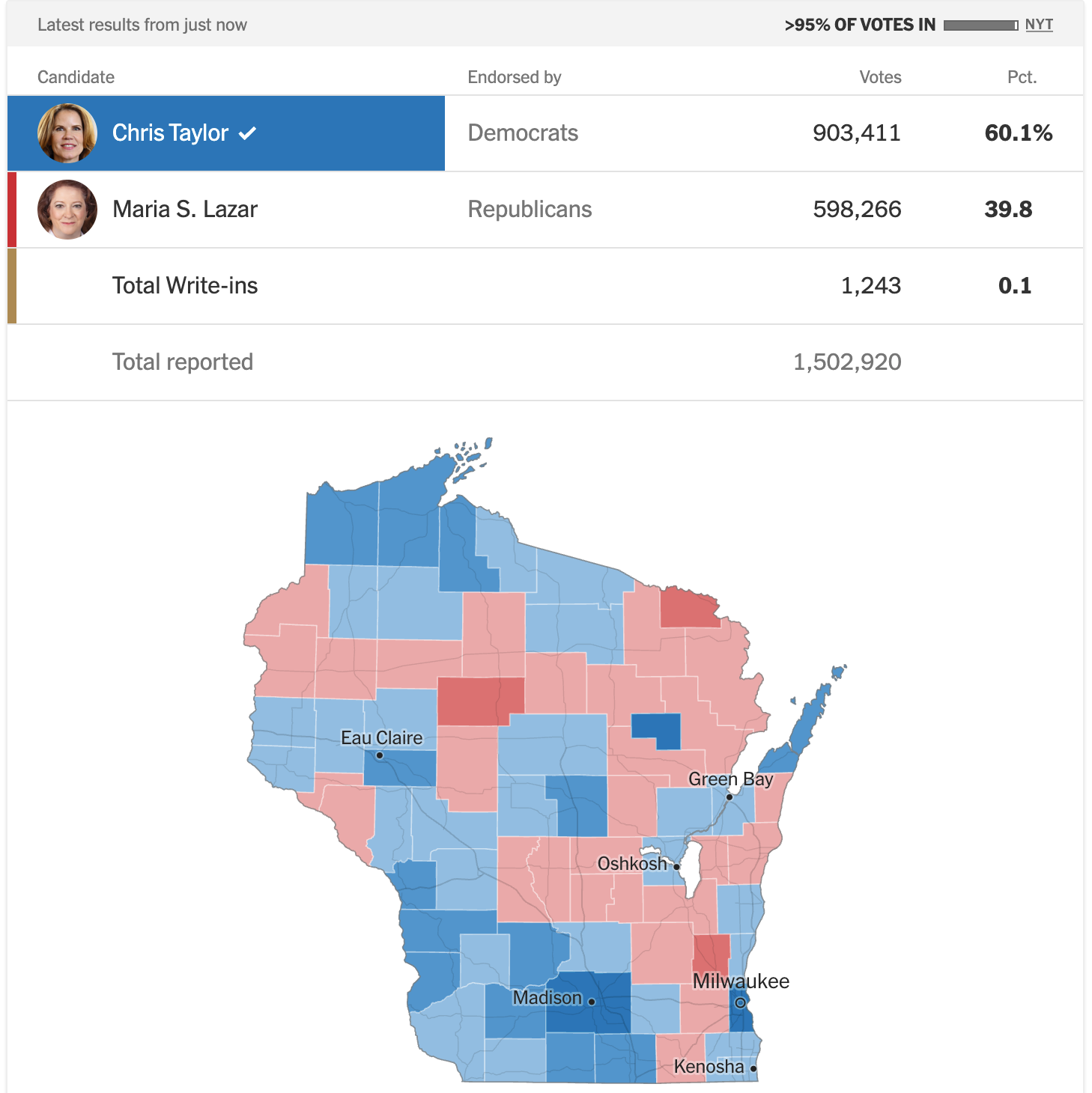
It was a big deal a year ago when Susan Crawford won 10 counties that were carried by Donald Trump just a few months prior in the 2024 presidential election. Taylor has pushed that a whole lot further, winning at least 24 Trump-won counties, including rural counties in western and central Wisconsin, swing counties in the Fox Valley, and sent the red WOW county wall crumbling by shrinking the Waukesha County margin to single digits and flipping Ozaukee County blue for the first time since 1964. She even won counties like Sheboygan (Trump+16), Jefferson (Trump+16), Marathon (Trump+19) and Vilas (Trump+23), and is within less than 1% of winning in Walworth (Trump+22) and Manitowoc (Trump+23).
It’s an astoundingly dominant victory. Taylor’s win also makes it four in a row for Democratic-aligned candidates in Wisconsin Supreme Court races, and will push the majority from 4-3 to 5-2, cementing liberal control of the court through at least 2030.
And this is in a state where Donald Trump won twice. While there are a great many factors driving this victory — turnout, realignment, so much more — perhaps Wisconsin voters want to see the check on Trump to be a judicial one.
Throughout the last decade of politics that make up the Trump Era, Republican candidates have fared reasonably well in congressional elections. Ron Johnson won in 2016 and 2022, Derrick Van Orden won close races in 2022 and 2024, and Bryan Steil has consistently overperformed. Part of what we’re seeing could be that voters might be more willing to support a Republican legislative agenda, but want to see the courts keep Trump in check. Because after the 2017 race where discombobulated Democrats didn’t field a candidate to challenge Annette Ziegler, they’ve gone 5-1 in Wisconsin Supreme Court races from 2018 to 2026, the only loss being to Brian Hagedorn by an especially slim 0.5% margin.
Such a check on Trump is obviously a sorely needed one. This was the closest court in the nation to siding with his efforts to overturn the 2020 election, after all. By next year, all three of the right-wing justices who sided with Trump will be gone from the state’s highest court. And it was Trump’s appointees who led to the overturn of Roe v. Wade, which emerged as a central issue in the last three state court races, in particular. Redistricting, too, has been an issue where the public has sided against Trump. And for as much as folks on the right like to characterize the court as being extreme, it’s currently the most favorably-viewed branch of government in the state, according to the latest polling from Marquette.
But voters who might want a judicial check on Trump would not on its own begin to explain the magnitude of this particular victory.
Last year, election forecasting and analysis website Split Ticket put out a piece before the election with the heading, “Wisconsin Republicans Have An Off-Year Turnout Problem,” followed by a post-election piece on how turnout helped drive the liberal victory in the Spring Election race, estimating that “voters who voted in the 2025 Supreme Court election backed Kamala Harris by 7 points in 2024.” The lower propensity voters who drove Trump’s 2024 victory were not showing up in Spring 2025, leading to the 72-county shift that happened a year ago.
That turnout problem was supercharged this year, both through Lazar’s lackluster campaign and Taylor’s especially strong one, fueled in no small part by a gargantuan fundraising discrepancy between the two.
But it’s also because of how coalitions are changing. The political realignment we’ve been experiencing is a major factor in races like the ones in the Spring Election. The more reliable every-election voters are now much more likely to be voting for Democratic-aligned candidates than they were in a pre-Trump era. For a Spring Election — or perhaps even a midterm, if we’re reading some tea leaves — that’s going to tip the advantage toward left-of-center candidates who now have a hyper-motivated base to show up time and time again for each and every election. Participation is power, and liberals have flexed that power in races like these — perhaps no place more than here in Wisconsin.
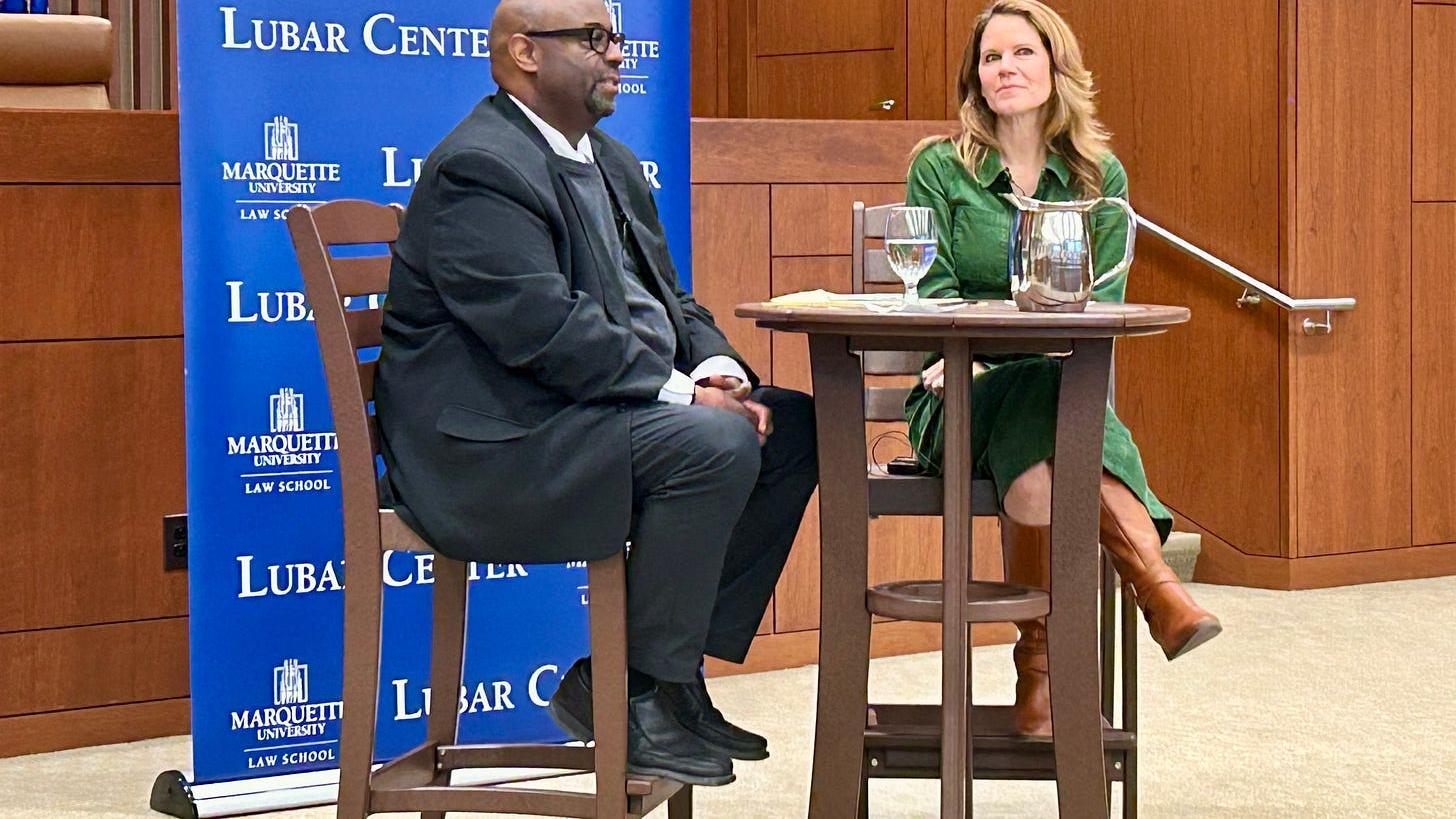
Taylor herself, too, deserves an enormous amount of credit for the race she ran. A few weeks ago, I attended Marquette Law School’s “Get To Know” event with Taylor, and came away especially impressed with her. I’d seen a number of those types of events in recent years, including another several weeks prior with Lazar, and Taylor’s really stood out. She was clear on her values and motivations, drew a stark but respectful contrast with her opponent, demonstrated a forward-looking vision for the court, emphasizing the importance of the judiciary in this current political moment. It was a home-run performance for someone who has proven herself to be a home-run candidate. She more than earned the 10-year term she’ll serve on the Wisconsin Supreme Court.
One of the things Taylor said in that conversation was that she wanted to see the court “take more cases.” The April 7 election results here have given her and the court’s now 5-2 liberal majority a resounding mandate to do just that.
In the book “The Fall of Wisconsin” by Dan Kaufmann, Chris Taylor, then a state representative in Madison, is among the individuals featured prominently, including a memorable scene on Election Day 2016 in the book’s prologue where she was not confident in wins for Hillary Clinton and then-senator Russ Feingold, recalling a challenging turn canvassing in Iowa County. A decade later, she’d win Iowa County by a whopping 34-point margin — a 26-point shift from 2024, among the biggest shifts in the state — en route to one of the biggest victories this swingiest of swing states has seen in ages. She proved herself to be the right candidate for the right time.
Now, through voters perhaps wanting a judicial check on an out-of-control president, by way of dramatic shifts in turnout and an ongoing political realignment, Wisconsin’s highest court will be in liberal control well after Trump is no longer president, and Chris Taylor will be on the bench until 2036. It’s quite the moment for Wisconsin.
Stay tuned for more analysis of the Wisconsin Spring Election results here at The Recombobulation Area in the coming days, with our usual “10 Takeaways” deep dive on the results of this race and much more.
Subscribe to The Recombobulation newsletter here and follow us on Facebook and Instagram at @ therecombobulationarea.
Already subscribe? Get a gift subscription for a friend.
Part of a group who might want to subscribe together? Get a group subscription for 30% off!
Follow Dan Shafer on Twitter at @DanRShafer, at BlueSky at @danshafer.bsky.social, and on Threads at @danshafer.