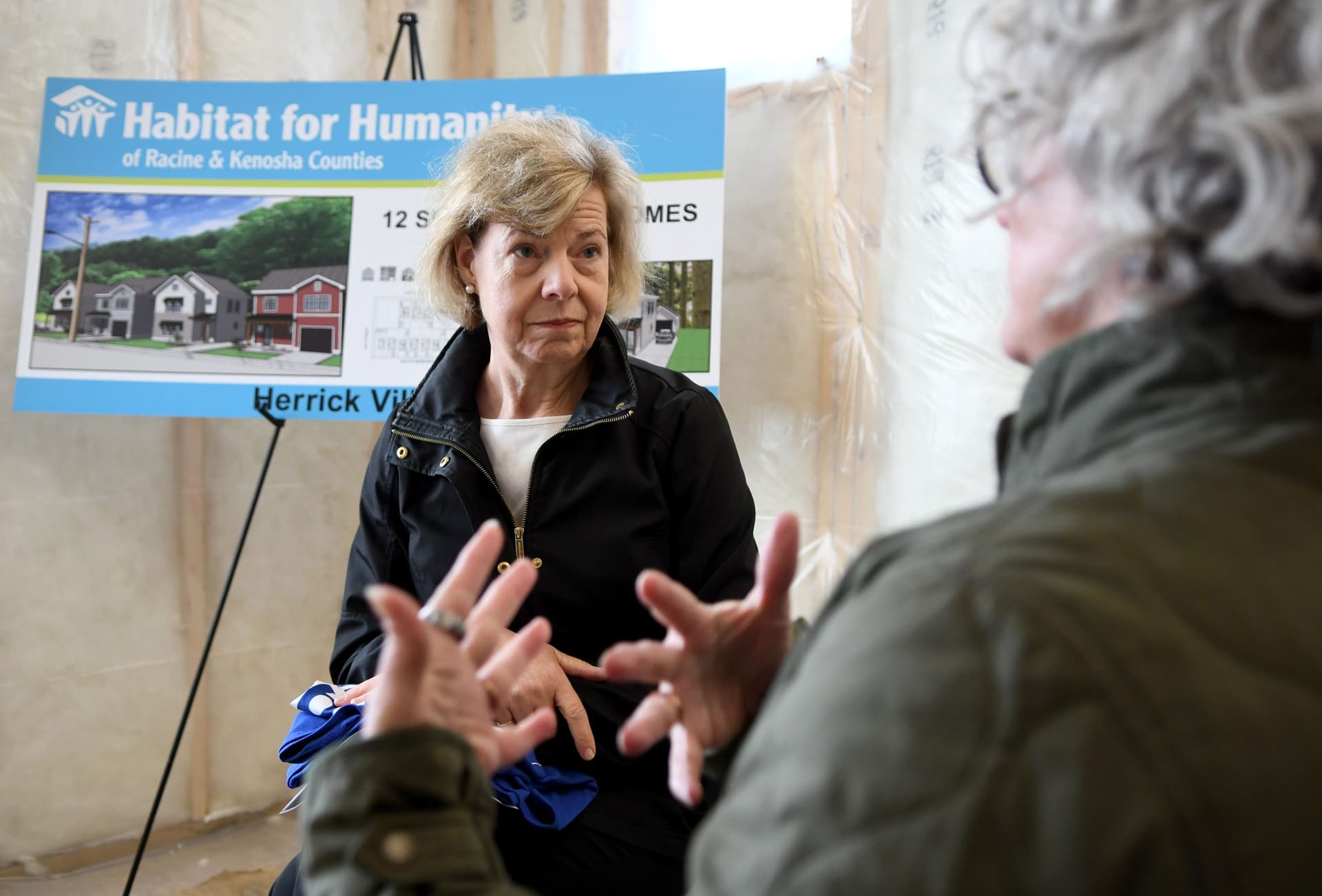


U.S. Sen. Tammy Baldwin visited Racine on Friday, making time after her tour of the Habitat for Humanity build at 10th Street and Memorial Drive to address a question that comes up frequently in Racine County: Where is Tammy Baldwin?
Sen. Ron Johnson and Rep. Bryan Steil both hold regular telephone town halls, and the comparison isn’t lost on constituents who want the same access from Baldwin.
She acknowledged the concern directly and outlined how she approaches constituent engagement differently: topical roundtables and in-person events across Wisconsin. She hosted more than 130 last year alone aired with at least a half hour of daily Wisconsin media interviews from Washington.
Her events tend to be issue-specific, she said, organized around whatever is most pressing for the communities she’s visiting.
“I want you to be able to write about how this big bill that you hear about in DC would affect Racine,” she said.
Housing: A federal bill with local stakes
Baldwin came to Racine from a housing-focused roundtable in Milwaukee similar to the one she hosted at the Habitat site, the city’s first subdivision dedicated entirely to affordable homeownership.
The 21st Century ROAD to Housing Act, which passed the Senate 89-10 in March and is in the reconciliation process with the House, is the legislation driving that conversation. The bill combines elements of both chambers’ housing packages and includes a provision that would ban large institutional investors from buying single-family homes, according to the U.S. Senate Committee on Banking.
Baldwin focused on a challenge that resonates personally: the interest rate trap locking current homeowners in place. She floated the concept of portable mortgages, allowing homeowners who locked in historically low rates in recent years to carry those rates with them if they choose to downsize, freeing up larger homes for younger families who need the space.
“Let’s be creative,” she said. “Let’s think out of the box.”
She also raised the role of community development financial institutions, mission-driven lenders that serve lower-income borrowers, that offer privately funded, below-market construction loans to help buyers bridge the affordability gap. The idea connects to a model already in use in Kenosha, where a private donation helped cap construction loan rates at 5.75%.
Baldwin noted that two-bedroom rents in Racine have climbed to approximately $1,149 per month — a 27% increase since 2021, according to the City of Racine rent index. At the same time, the median home sold price in Racine reached $245,000 as of May 2025, according to Rocket Homes.
She also pointed out a harder problem: even when affordable homes exist, they’re often in neighborhoods where grocery stores and pharmacies have closed and transit is unreliable.
“That’s also a problem that can’t really be solved from Washington, DC,” Baldwin said. “It’s going to take local and state leadership.”
The war in Iran: Illegal, costly, and ongoing
Baldwin has been one of the Senate’s most active voices pushing back on the U.S. war in Iran, which began Feb. 28. She sponsored a War Powers Resolution, one of five such votes forced by Senate Democrats, that would have directed the president to halt military operations without explicit congressional authorization.
The Senate voted 46-51 to defeat the most recent measure, with Sen. Rand Paul the only Republican to vote with Democrats and Sen. John Fetterman the only Democrat to oppose it, according to a report from The Hill.
The costs of this conflict only grow. NBC News notes that the Pentagon confirmed the war has cost approximately $25 billion to date, with most of that spent on munitions. Other news outlets and U.S. officials have suggested the actual figure is significantly higher when base damage and other costs are included. Thirteen U.S. service members have been killed and approximately 373 wounded as of early April, according to TIME magazine.
Wisconsin gas prices crossed $4 per gallon as of late April, their highest point in four years, in large part because Iran closed the Strait of Hormuz, according to AAA data reported by Wisconsin Public Radio.
Baldwin said the War Powers Act gives Congress both the authority and the responsibility to act, and she’s not planning to stop forcing the issue.
“Iran wasn’t attacking us,” she said. “That’s not a reason to bring a nation to war.”
She noted that Republican support, while thin, has been growing incrementally, from one GOP vote on the first war powers resolution to two on the most recent, with a handful of others signaling they would reconsider their position after the 60-day mark. May 1, the day Baldwin visited Racine, was that deadline.
Farmers, food, and the ripple effects
The war’s economic fallout doesn’t stop at the gas pump. Baldwin raised concern about Wisconsin farmers who may not be able to afford fertilizer, saying that approximately a third of the world’s fertilizer supply moves through the Strait of Hormuz.
“There will be farmers in Wisconsin who forego putting crops in the soil because they can’t afford the fertilizer,” she said.
She also noted the compounding effect of tariffs cutting off export markets like China, which previously bought significant quantities of Wisconsin soybeans and ginseng.
“They used to buy our soybeans. Well, they don’t anymore,” Baldwin stated.
She also noted that the Trump administration abruptly ended a Farm to Food Pantry program and a Farm to School program that had supported roughly 300 Wisconsin farmers, creating ripple effects for food pantries and families who rely on them.
Bipartisan work, quietly
One of the more surprising threads of the conversation was what Baldwin described as ongoing bipartisan cooperation that rarely makes headlines, partly by design.
As a member of the Senate Appropriations Committee, Baldwin said the committee has been quietly restoring funding that the Trump administration sought to cut: the Centers for Disease Control, NIH research, and AmeriCorps among them. The bills pass, Trump signs them, and the programs continue but without the kind of public fanfare that might invite presidential intervention.
“If we publicized it a lot and talked about it a lot, it would fail,” she said, “because Trump would notice.”
She also pointed to work across the aisle with Midwestern Republicans on rebuilding domestic manufacturing, a shared priority for industrial states like Wisconsin, Indiana, and Ohio. She said the collaborative instinct isn’t entirely new, citing past legislation she introduced with then-Sen. JD Vance when both were focused on keeping manufacturing jobs in their respective states.
988: A bipartisan win facing a new threat
Baldwin was the lead Democrat on the legislation that created the 988 Suicide and Crisis Lifeline, and she’s been using her Appropriations Committee seat to ensure it stays funded and fully operational.
A study published April 22 in JAMA, and noted in a report from U.S. News & World Report, found that suicide rates among young people ages 15 to 34 dropped approximately 11% after 988 launched — translating to an estimated 4,372 fewer deaths than projected between July 2022 and December 2024.
The Trump administration cut off 988’s specialized option for LGBTQ+ youth, a population with disproportionately high suicide rates, but Baldwin said the Appropriations Committee put the requirement back into law, and she pressed Health Secretary RFK Jr. directly on implementation during a recent hearing.
“It’s in the law,” she said. “You have to do this.”
He committed to restoring it, she said. Whether that commitment is followed through remains to be seen.
If you or someone you know is in crisis, call or text 988.