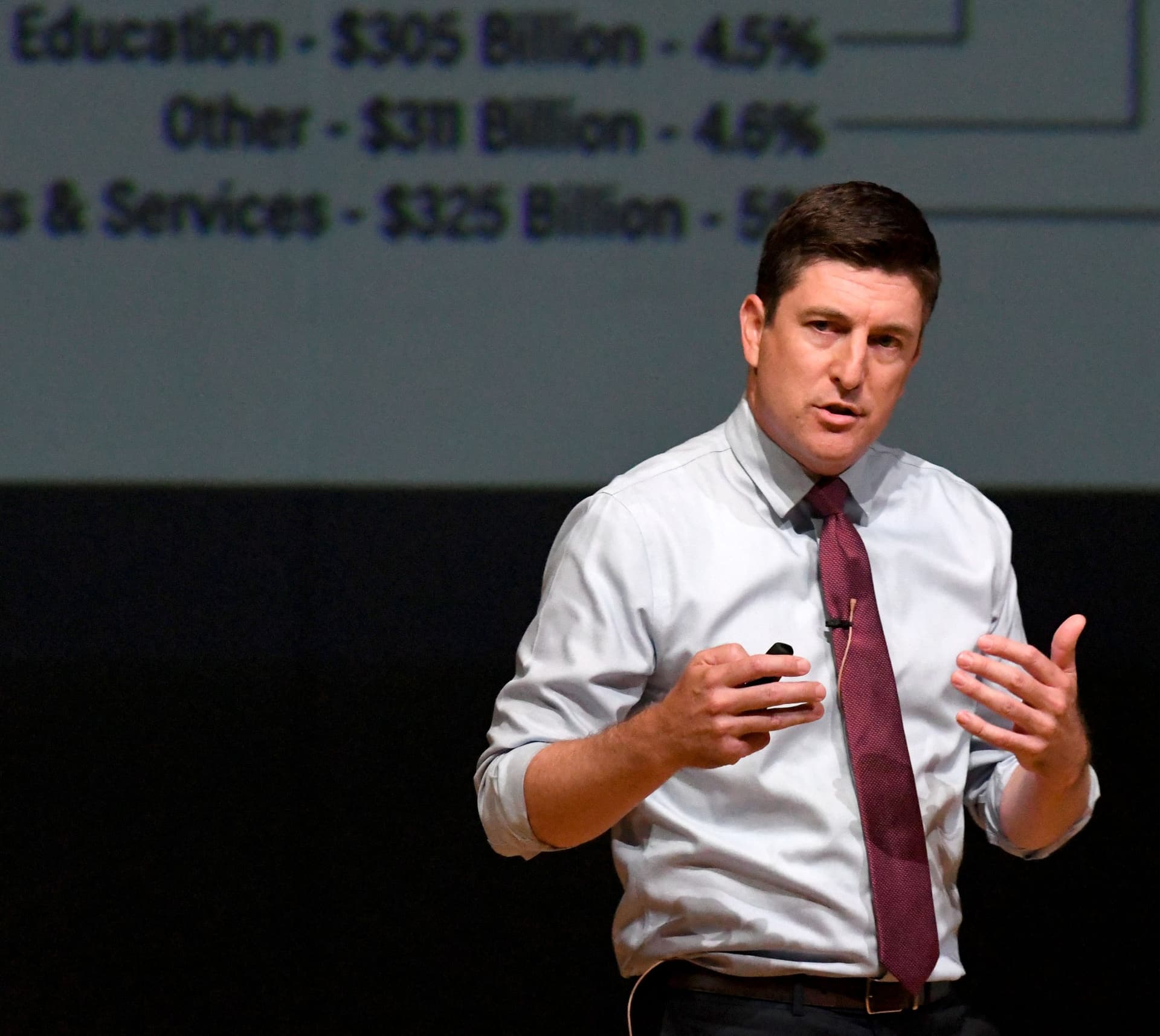


During a Feb. 25 telephone town hall, U.S. Rep. Bryan Steil defended his legislative priorities on election integrity, Medicaid changes and congressional stock trading while again promoting claims about voter fraud and election administration that have been repeatedly reviewed and rejected by courts, audits and state election officials.
The Janesville Republican pointed to the need to restore “confidence” in elections, even as multiple investigations in Wisconsin and nationwide have found no evidence of widespread fraud affecting outcomes. constituents who asked que
1. SAVE Act and noncitizen voting
Question (Matthew, Lake Geneva):
What is the actual problem that you’re trying to fix with the SAVE Act? … The Heritage Foundation just came out and the actual incidents of non-Americans voting is infinitesimally small. … Is it worth the turmoil that it’s going to cause for people like my wife? And finally, why is there no transition period?
Steil’s answer:
I think there’s a real need and opportunity to increase Americans confidence in our elections … I think the two key principles of putting in a citizen verification process and a photo identification process increases our level of confidence … There is a lot of back and forth as to how many non-citizens are on the rolls… about 30 years ago… in one house race… about 800 individuals were non-citizens. That’s a significant number. We do know that non-citizens are registering … under current federal law, when an individual gets a driver’s license, they’re automatically handed voter registration material … Those that are already registered … would actually cross reference those individuals against citizenship verification information to try to make sure we’re removing any given non-citizen … An individual would either be able to do a full self-attestation… or cast a provisional ballot. The ultimate goal here is to make sure that everyone is able to vote who is eligible to vote.
Fact check
- Federal law already prohibits noncitizens from voting in federal elections. Multiple studies — including analyses by the conservative-leaning Heritage Foundation — have found documented cases to be rare relative to total votes cast.
- The National Voter Registration Act requires states to offer voter registration opportunities at DMVs, but applicants must attest under penalty of perjury that they are U.S. citizens. Providing registration forms is not the same as automatically registering noncitizens.
- The 1990s North Carolina congressional race Steil referenced did involve allegations of noncitizen voting; however, election investigations since then have generally found isolated incidents rather than widespread voting by noncitizens.
- Research on voter ID laws shows mixed evidence on whether they increase public confidence; some studies suggest they can reduce turnout among certain groups, particularly voters who lack required documentation.
Sources:
- Bipartisan Policy Center explanation of noncitizen voting legality and penalties
- Migration Policy Institute explainer on noncitizen voting in U.S. elections
- U.S. Government Accountability Office (GAO) report on voter registration list maintenance
2. Question: “Delilah Law” and commercial driver’s licenses
Question (Alyssa, Kenosha):
Trump’s proposal … the Delilah law … prohibiting CDL licenses from being issued to illegals and non-citizens … Does this require legislation … or could this be done via an executive order?
Steil’s answer:
CDLs are governed by state law in all 50 states … Ultimately what this is, is we’re looking at federal legislation to set a floor and a benchmark … that those individuals have to be able to read English and they need to be a citizen or … a green card … The benefit of it going through the legislative process is it’s solidified and it’s done and it’s not subject to the whip saw of who wins the presidential election.
Fact check
- Commercial driver’s licenses are issued by states but regulated under federal standards through the Federal Motor Carrier Safety Administration. Federal law already sets baseline requirements for CDLs used in interstate commerce.
- Lawful permanent residents (green card holders) are currently eligible for CDLs in many states. Policies vary on documentation and verification standards.
- Changes to CDL eligibility tied to immigration status could require federal legislation if altering statutory standards; however, some regulatory adjustments can be made through executive agencies depending on existing authority.
- The specific case Steil referenced about the death of a child received media attention, but broader data does not show that noncitizen CDL holders are a primary driver of national crash statistics.
Sources:
- FMCSA’s CDL Requirements
- U.S. Citizenship and Immigration Services (USCIS) for driver’s licenses and immigration status
- FMCSA crash data for large trucks and buses
3. Question: Medicare and Medicaid cuts
Question (Paul):
What’s the meaning of the cutting to Medicaid and Medicare? I have three medical daughters that rely on it … her emergency medication is no longer considered covered … what’s the meaning of the cutting … and do they understand how effective it is going to be?
Steil’s answer (excerpt):
In the legislation that was passed last summer, there were no changes to Medicare’s programs … No changes have gone into effect, and they will not go into effect until 2027… The only change of substance … is a check not once a year but twice a year … and work requirements on able-bodied childless adults of working age.
Fact check
- The changes Steil referenced stem from the so-called “Big Beautiful Bill Act,” which includes new Medicaid eligibility verification requirements and work requirements for certain adults. While implementation timelines vary, major provisions would require federal approval and state-level rollout before affecting beneficiaries.
- Independent estimates from health policy analysts project that tens of thousands of Wisconsinites — and potentially more depending on state implementation — could lose Medicaid coverage due to new work requirements or more frequent eligibility checks. National projections estimate millions could lose coverage under similar provisions.
- Data from the Kaiser Family Foundation show that most adult Medicaid recipients under age 65 are already working, and many of the rest report caregiving responsibilities, illness or disability as reasons for not working. Research on prior state work requirement experiments found coverage losses were often driven by paperwork barriers rather than changes in employment.
- Medicaid coverage disruptions have already occurred nationwide since the end of the federal COVID-19 continuous coverage policy, when states resumed eligibility redeterminations. Millions of Americans, including eligible individuals, were removed from Medicaid rolls during that process.
Souces
- Congressional Budget Office (CBO) cost estimate and losses under Medicaid
- Congressional Research Service (CRS) Medicaid work requirements and federal authority overview
- KFF (Kaiser Family Foundation) – Medicaid work requirement impact estimates by state
- Wisconsin Department of Health Services – BadgerCare Plus enrollment data
- Arkansas Medicaid work requirement evaluation (New England Journal of Medicine)
4. Question: Stop Insider Trading Act
Question (Jerome, Caledonia):
You had sent me an email about passing a bill that the people in Congress would not get the closest bid on stocks that were going to go all over, where the regular person wouldn’t know about it. Did you pass that? Did you get that bill passed?
Steil’s answer (excerpt):
I drafted a bill … we called the Stop Insider Trading Act … to prevent members of Congress from even being in a position to benefit off insider information … It’s through the committee process … The president has called on Congress to pass it… I think we’re going to see it move to the House floor in the near future.
Fact check
- Members of Congress are already subject to the STOCK Act of 2012, which prohibits insider trading and requires financial disclosures.
- Multiple bipartisan proposals in recent years have sought to ban individual stock trading by members of Congress. As of Feb. 25, Steil’s proposal had advanced through committee but had not yet been enacted into law.
- Public polling consistently shows strong bipartisan support for banning or restricting congressional stock trading.
- Enforcement of the STOCK Act has been criticized as uneven, and penalties for violations have often been minimal.
Sources
- Text of the STOCK Act (Stop Trading on Congressional Knowledge Act of 2012)
- https://www.congress.gov/bill/112th-congress/senate-bill/2038
- Congressional Research Service — Insider Trading and Congressional Accountability
- https://crsreports.congress.gov/product/pdf/RL/RL34530
- Business Insider investigation on STOCK Act violations and penalties
- https://www.businessinsider.com/congress-stock-act-violations-senate-house-trading-2021-9
- University of Maryland Critical Issues Poll — Public support for banning congressional stock trading
- https://criticalissues.umd.edu/poll/congressional-stock-trading
5. Question: Election integrity and misleading ads
Question (Joe, Pleasant Prairie):
If you look at Wisconsin … the whole state pretty much red unless you go into Door County, Madison or Milwaukee … with the upcoming midterms and the next election, election integrity is everything. If we can’t assure that these elections are being run honestly, I just don’t trust these people. Do you have the same thing where you just can’t believe that we can look at the same thing as a liberal but we see it completely different? And then the other thing was, there’s a firefighter here … those commercials that I see on YouTube all the time, and he misrepresents everything you do, and I don’t know how they get away with that either.
Steil’s answer (excerpt):
I look at the misleading television ads we see time and again and shake my head … they want to fear monger and scare people rather than tell them the truth … I agree with you. I think improving Americans’ confidence in our elections is a huge deal … I want to make sure we pass the SAVE Act … not only photo identification and U.S. citizens voting, but also that elections should end on election day… you shouldn’t have people being paid to run around and collect ballots … we should be using paper ballots that are auditable … All of these are the principle of making sure that it’s easy to vote and hard to cheat.
Fact check
- Wisconsin elections are administered by municipalities and overseen by the bipartisan Wisconsin Elections Commission. Multiple post-2020 reviews, including audits and court rulings, did not find widespread voter fraud that would have changed election outcomes in the state.
- The Legislative Audit Bureau conducted a 2021 audit of the 2020 election and identified administrative issues but did not conclude that fraud altered the results.
- Wisconsin already uses paper ballots statewide, which can be recounted and audited. State law also permits absentee voting and ballot return by the voter; third-party ballot collection is restricted under recent Wisconsin Supreme Court rulings.
- Research on voter confidence shows partisan divides in perceptions of election integrity. Studies from institutions including the Pew Research Center have found that views on election fairness vary significantly by political affiliation, even when underlying election systems are unchanged.
Sources
- Wisconsin Public Radio: Election Security & Administration
- Wisconsin Supreme Court decision on 2020 election challenges (Trump v. Biden, 2020 WI 91)
- PBS News’s Evaluation of the 2020 Election
- ABC News: Officials push back on ballot drop boxes
- Pew Research Center: Republicans and Democrats Move Even Further Apart in Confidence in 2020 Election